
Ancient Networks
But, after all, who knows, and who can say Whence it all came, and how creation happened? The gods themselves are later than creation, so who knows truly whence it has arisen?

Shared beliefs. That is what allows humans to be powerful despite lacking several of the physical strengths prevalent in our animal relatives. And turns out religion is the way our ancestors chose to galvanize our societies. In this blog, I explore what connections our Vedic luminaries drew between humans and the heavens in order to organize Bharat.
While I'll dive into some observations I made, I'd invite you to explore your own curiosities here. I've tried cleaning data as much as possible but do let me know if you find inaccuracies and I'll do my best to fix those. And I know I tread on delicate ground here so if anything offends your sensibilities - please forgive my transgressions.
The New Order
“ In the beginning desire descended on it - that was the primal seed, born of the mind.
- 10.129.4

I've often heard that the vedic religion was based on nature worship. And its true. We do have a staggering number of gods associated with natural phenomena. But obviously we have a fair share of non-nature related deities. In this picture itself, we see that Aditi(progenitor of the Adityas), Mitra(protector of treaties) and Asvins(gods of healing) were a significant part of the Vedic pantheon. Varuna was the law-giver and the sky god before Yama in true Truth can only be glimpsed through the eyes of the dead style took over justice and Indra took over the skies. Savitar or Savitr used to be a pretty important solar deity (the Gayatri Mantra is dedicated to him) before receding in prominence. Maruts were thunder gods before a lot of their duties got absorbed into Indra. The story of Soma is pretty interesting and deserves its own discussion. Let's just say some drinks came to become so influential that from elevating humans from this earthly plane they underwent their own apotheosis🍻.
Indra occupied the center of Vedic worship. Unlike the more sombre, measured gods of their contemporaries, Indra epitomized desire. And of course, he was counterbalanced by Mitra/Varuna's (Mitra seems to have inspired a cult in Roman legionnaires leading to Mithraism) rta. But between chaos and order there was the desire for order.
The Eternal Mother
“ अदितिर्द्यौरदितिरन्तरिक्षमदितिर्माता स पिता स पुत्रः |
विश्वे देवा अदितिः पञ्च जना अदितिर्जातमदितिर्जनित्वम ||
Now thats one powerful goddess! Aditi is all of divinity rolled into one supreme being. In Mandala 1 (1.113.19), she is revered as the mother of the gods, yet by Mandala 2 (2.27.7) she is invoked as the mother of kings. We can see how she is connected to some of her popular children in the image above.
I feel this is such a classic motif across ancient civilizations (and even today with all the God lives in the Panch jazz and in western cultures till the 2 kingdom theory propounded by Martin Luther). Rulers trace their lineage to the divine, grounding their authority in sacred ancestry. In this case the divine mother thus becomes not just a symbol of creation, but also the legitimizer of dominion and cosmic order.
Rivers and Migrations
“ Where must we go... we who wander this wasteland in search of our better selves
- The First History Man
Here's the mentions of a few rivers in the Rigveda


Disclaimer. I know the mandalas aren't arranged chronologically so maybe I'm stretching the truth here, but the observation was just too striking to ignore.
Sindhu finds most of its mentions in the first book, while Yamuna appears in the fifth and tenth, and Ganga and Gomati emerge only in the tenth. To my simple mind that felt like the unmistakable sign of migration south-eastwards. Until of course, a google search just brought the neat little theory crashing down that is.
Salut to the Ethereal God
“ Visions come to prepared spirits

Now that was an unavoidable pun huh? The use of Soma - cognate with the haoma of the Zoroastrians and the souma of the Scythians was deeply woven into the fabric of Vedic ritual and reverie alike. Not to relegate them as completely bacchanalian but the paeans sung to exalt the drink are unmistakable. The Rigveda declares We have drunk the Soma and become immortal and attained the light the Gods discovered. (8.48.3) - something that in my mind sort of blurs the line between holiness and ecstasy.
Notice how the invocations of Soma crescendo in Mandala 9. Well, thats because Mandala 9 is the Soma Mandala dedicated entirely to Soma. Soma is lauded as the source of vitality, health and abundance. Yet by 10.36.8, he evolves into Chandra, the lunar deity: “May we master that power, Soma, whose rays shine bright…” And thats quite some transformation - from elixir to divinity, from drink to the very essence of celestial light.
The Nasadiya Sukta
“ I am not young enough to know everything.
Oscar Wilde
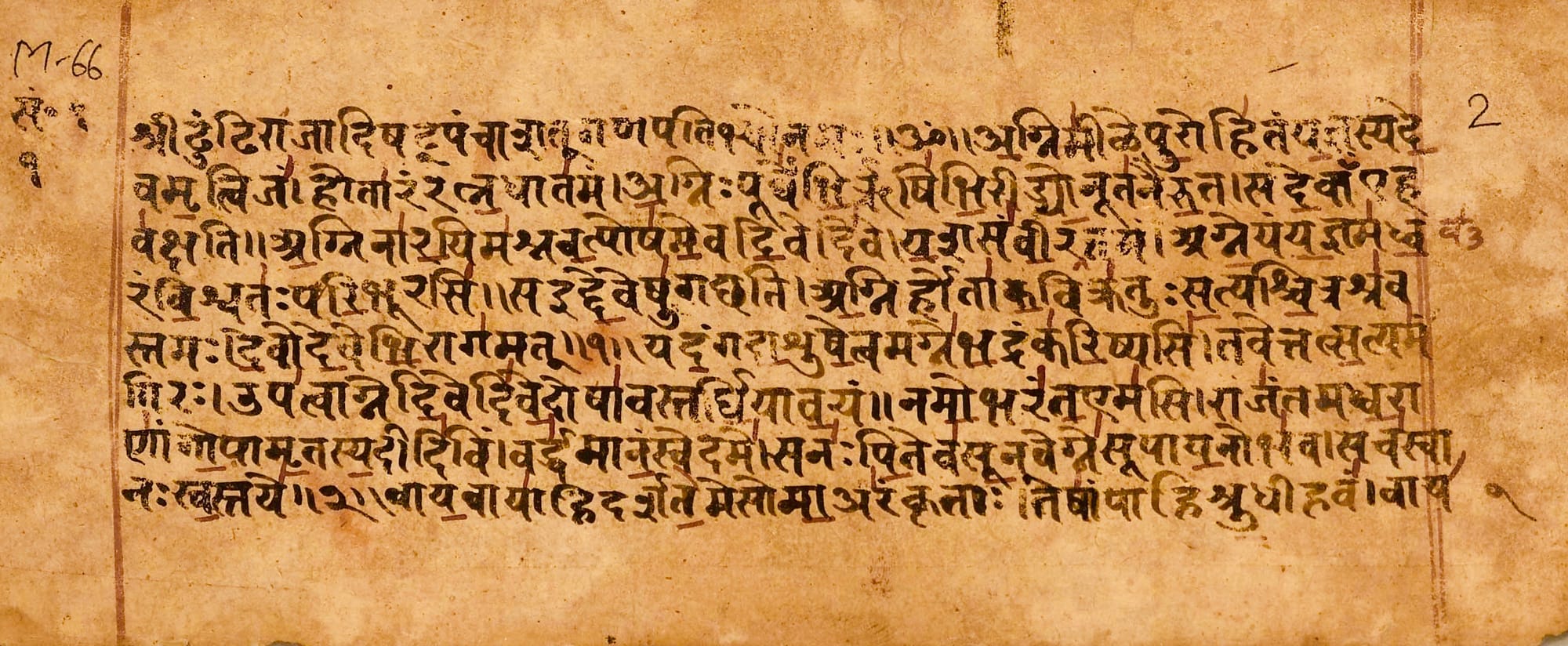
The excerpt has a fragment of this sukta. The hymn of creation is the 129th hymn of the 10th book. Desire may be the root cause of suffering (one of the four noble truths of Buddhism). But as it points out - it is also the very seed of creation. And the fact that it acknowledges there are things even the gods do not know - well to me its almost like a call to find out for myself.
Concluding thoughts
“ Ekam sat vipra bahudha vadanti - Truth is one. The wise call it by many names
Every era has had its basis for stability. From animism to God-kings, polytheistic belief systems, monotheistic orders - we've designed multiple layers of systems to organize, connect and transcend what we can individually achieve.
While modern civilization has moved away from religion, I don't believe we've moved away from faith, not entirely at least. Forms have changed but the yearning to build something greater than our selves remains. And today we find that same courage in fiat currencies, corporate manifestos and the infallibility of human technology.
PS: Check out https://rigveda.pratiksanghavi.in/; There's so much more that can be gleaned!